Blog
How to follow up after a sales call
What goes in the follow-up after a sales call, when to send it, what the CRM should say afterwards, and how Cedric drafts both from the call for your yes.
 Benjamin Ben Hattar
The call went well. They asked good questions and agreed to a pilot. Then the next call started, and the follow-up that would have taken ten minutes went out the next afternoon. The CRM still says "Discovery".
A follow-up after a sales call is two jobs. One is the email to them, which keeps the deal moving. The other is the record for you, which keeps the pipeline honest. Both come from the same notes, and both go stale within a day.
- Send the follow-up the same day, while both sides remember the call.
- Five parts: their problem in their words, what you agreed, who does what by when, what you promised, the next meeting.
- Short enough to read on a phone. It records the call. The pitch already happened.
- Update the CRM in the same sitting: stage, next step with a date, close date, new contacts, three lines of notes.
- Cedric drafts the email and the CRM changes when the call ends. Nothing is sent or saved until you say yes.
What goes in the email
- 01
Their problem, in their words
Open with one line that shows you listened. Use their phrase, not your product's. "You want the support team live before renewal" beats "Great to learn about your goals".
- 02
What you agreed
The decisions, stated plainly. If something was discussed and left open, say it is open. A buyer forwards this email to people who were not on the call, and they need to tell a decision from an idea.
- 03
Who does what, by when
Both sides. Your tasks and theirs, each with a name and a date. Their half matters more: it is the part that shows whether the deal is real.
If they owe you nothing, the call did not produce a next step. Fix that before you write the email.
- 04
What you promised to send
The security pack, the pricing, the case study. Attach it now. "I will send it over" in a follow-up is a second follow-up waiting to happen.
- 05
The next meeting, with a time
Propose a slot instead of asking when they are free. Put a real calendar invite behind it.
An example
Subject: Fenwick pilot, next steps
Priya, thanks for today. You want to prove this with the support team before anyone signs, and security has to be satisfied first.
What we agreed: the pilot starts October 1 with the support team, 12 seats. The security review happens before the contract.
Next steps: you send the security questionnaire. I have attached the pilot plan and our security pack. We review together on Thursday at 14:00, and the invite is in your calendar.
That is about eighty words. It fits on a phone screen, and anyone Priya forwards it to knows where things stand.
When to send it
The same day, and inside the hour if you can. The buyer still has the call in their head and can correct you if you got something wrong. Send it later and a wrong detail becomes the record.
If the call ended at six, send it first thing the next morning, before your own day starts. The one timing that costs you is the follow-up that goes out after they have had time to talk to your competitor.
The CRM, in the same sitting
Five fields carry most of a deal's truth. What to write, the usual mistake, and what Cedric proposes when the call ends.
| Field | What to write | The usual mistake | What Cedric proposes |
|---|---|---|---|
| Stage | Move it when the buyer did something | Moving it because the call felt good | The new stage, from what was agreed |
| Next step | An action, an owner and a date | "Follow up" with no date | Next step with an owner and a date |
| Close date | The date the buyer gave, or none | A date nobody said | The date heard on the call |
| Contacts | Everyone new who joined the call | Leaving the new person out | The new contact, with their title |
| Notes | Three lines and the objections | A pasted transcript nobody reads | A summary, with the call as the source |
Every change Cedric proposes waits for a yes in the channel before it is written.
The Cedric version
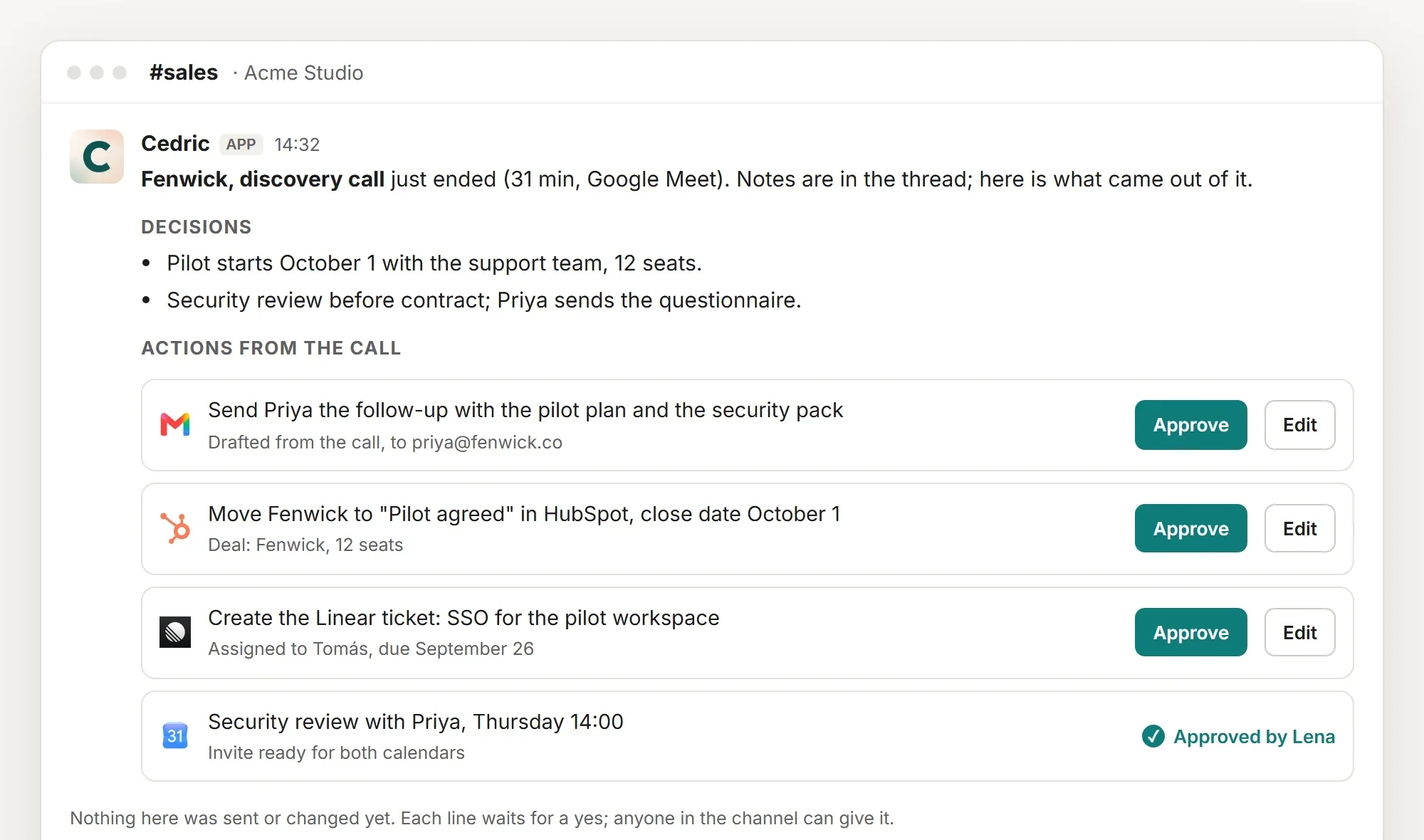
Cedric joins the call as a visible guest, from the call link or from his address on the calendar invite. When the call ends he posts one message in your channel. It holds the decisions and a draft of the recap in your voice. It also holds the CRM changes from the table above and the next meeting at a time that is free on the calendar. Each item has its own approve button. The picture below is that message, drawn in our own card style.
Set it up once
- 01
Put him on the calendar
Add Cedric's address to the invite, or to the whole recurring series, and he joins on time. For an unplanned call, paste the link in the thread and ask him to join.
Tell the room he is there at the start. He appears in the participant list like anyone else.
- 02
Ask for the follow-up once
"Join every customer call on my calendar and propose the CRM update after." From then on, every call ends with the recap drafted and the record proposed.
- 03
Approve, edit or hold
Read the draft, change a line if you want, and approve. The email goes out, the deal updates in HubSpot or Salesforce, and the invite is sent. Silence sends nothing.
- 04
Let him keep the thread alive
Action items get filed with an owner and a date. If an owner goes quiet before the next call, they get a nudge, and if it stays quiet you hear about it.
The full picture is on the meeting-to-CRM page and the meeting follow-ups page. For what he does inside the call itself, see Cedric in meetings.
What still needs a person
The tone with this buyer. The draft is written from the call. You know whether this person wants two lines or a full page. Edit before you approve.
The stage. Cedric proposes it from what was said. Whether a warm call is a real pilot is your call, and he waits for it.
Anything commercial. Discounts, terms and custom pricing stay with you. Say them in your own words.
FAQ
The same day, ideally within the hour. If the call ended late, send it first thing the next morning. The point is that the buyer can still correct anything you got wrong.
Their problem in their words, what you agreed, who does what by when, anything you promised to send, and the next meeting with a proposed time.
Short enough to read on a phone. Around a hundred words is plenty for most calls. It records the call and does not repeat the pitch.
No. The recap waits as a draft in the thread. Send it, edit it first, or hold it. The CRM changes and the invite wait the same way.
Paste the notes or the transcript in the thread and ask for the follow-up. The recap, the CRM update and the tasks come out the same way.
Free to start, no card.